What God Does With Our Messes
So Abimelech warned all the people, saying, "Whoever touches this man or his wife shall surely be put to death." -- Genesis 26:11; English Standard Bible
We've all made messes of things in our lives at some point or the other. I've made my share of mistakes, messes and committed my share of sins. I could tell you story after story after story, but I won't. I could share physical illustrations of this or I could share spiritual illustrations, but I won't. Instead, let's concentrate on the main thing, instead of the man thing; namely, let's put our focus squarely on God.
By now, due to the past few devotions, you know this story. A recap: Isaac and Rebekah moved to Gerar. God promised to bless them in that place. Isaac lied about his relationship with Rebekah, saying she was his sister rather than his wife. He was busted and came clean. Now...
Here, in today's chosen verse, we see clearly how God works our messes out for His glory and often for our good. We see it through continuing to put Isaac's story under the microscope. Abimelech had been pretty upset that Isaac's deception had caused the potential for himself or one of his subjects to commit adultery with Rebekah. Abimelech's response to this was unusual; one would think Abimelech would have punished Isaac. Instead, Abimelech basically says, "Anyone that does harm to Isaac or Rebekah will be put to death." This was the customary punishment for adultery among the Canaanite people. Not only that, but it had the king's personal stamp on it.
You might be thinking, So what? Read the next few verses (12-14) and you will clearly find that Isaac prospered in a big way. His crops produced a hundredfold. He had many herds and flocks and became a very wealthy man.
So, Isaac got lucky, right? NO!!! Don't forget the MAIN THING...GOD made a promise to bless Isaac (verse 3). You see, when Isaac did what he thought was wise to do he messed up. But, as is ALWAYS the case, the story is not really about Isaac. The story is about God. God is a promise keeper. God is a redeemer. God is a reconciler.
God can take our mess and use it. Isaac got the attention of Abimelech with a lie. God used that attention to insure Isaac's safety, which enhanced Isaac's opportunity to excel.
You've made messes. I have too. You might be in the midst of a mess right now. If we will come clean with the Lord, He will forgive us, give us a clean slate and set us back on the road to walking in His promises and receiving His blessings. And, get this, it won't be because you are good; it will be because HE is!
What mess have you made that you need to own-up to today? What thing MIGHT you be in the middle of today that you need to repent of? Do it! Believe me, when we are humble before our God, He can not only set things right, He can do far more than we could imagine or think.
Let God do a wonder beyond your mess today.
Sunday, November 12, 2006


Friday, November 10, 2006
Little Concessions / Big Consequences
Little Concessions / Big Consequences
Abimelech said, "What is this you have done to us? One of the people might easily have lain with your wife, and you would have brought guilt upon us." -- Genesis 26:10; English Standard Bible
George O'Leary told a lie. He had been newly hired as the coach of Notre Dame University's football team. The university officials performed a background check. They discovered that Coach O'Leary lied about his experience and credentials. Notre Dame discovered that O'Leary did not have the master's degree he claimed to have and they discovered Mr. O'Leary had not even played college football, though he said he'd played for three years at New Hampshire. Coach O'Leary said*, "Many years ago, as a young married father, I sought to pursue my dream as a football coach. In seeking employment I prepared a resume that contained inaccuracies regarding my completion of course work for a master's degree and also my level of participation in football at my alma mater. These misstatement[s] were never stricken from my resume or biographical sketch in later years."
All this went down FIVE DAYS after he'd been hired. Ironically, O'Leary had coached at another high profile school and in the professional ranks for several years under the same lie. It finally caught up with him. His lie cost him his job, it embarrassed him and it embarrassed the reputation of the University of Notre Dame. Commenting further, Coach O'Leary said*, "Due to a selfish and thoughtless act many years ago, I have personally embarrassed Notre Dame, its alumni and fans."
Of course, this being America, he got another coaching job like nothing had ever happened. It's not as high profile as Notre Dame, but a job coaching football.
Abimelech** was obviously a wise man and a moral one as well. He was outraged and bewildered that Isaac would lie about his relationship with Rebekah. If you will allow me a paraphrase: "Isaac, what in the world did you think you were doing? Don't you realize that your attempt at deception could have caused your wife to be unfaithful with one of our people?"
Little lies; little concessions. Rarely do we foresee how far they could go. The best thing is not to tell little lies or make little concessions.
I don't know if we can foresee what MIGHT become of little concessions. Do you think, when Coach O'Leary first sought a job in the coaching ranks, that he ever thought he would be offered the most prestigious coaching job in the entire country? I doubt it. I think he just wanted to get his foot in the door. Little did he know that he would one day work as defensive coordinator of the 1990 National Championship Georgia Tech Yellow Jackets. Do you think that he foresaw that as the catalyst for many other opportunities? I doubt it, but that's what happened. He probably thought about his lies often, but had gotten too far in to get out.
That's what happens.
I would imagine the same thing happened to Isaac. He probably didn't think he would be in Gerar that long. He only went there because of a famine where he lived (Genesis 26:1). While he was there Isaac got a word from the Lord to stay there (Genesis 26:3). Men asked Isaac about Rebekah; he said, "She's my sister" (Genesis 26:7).
Here is where Isaac failed and where most of us fail as well; he stopped trusting God and started looking around instead of up. God had plainly told Isaac that He would bless him (Genesis 26:3-4). Instead of holding God to His promise, Isaac feared men and made a concession, told a lie. It was just a little thing. Thank God nothing came of it, but MUCH could have gone wrong.
What is the point to all of this today? Let us endeavor to walk carefully, fearing our God in all things, scorning the opinion of men where it might cause us to gain the reproach of God. Tell no lies. Make no concessions that may cause us to sin.
Little lies, little concession MAY lead to big consequences. People may or may not ever realize our wrong. God always knows. Trust Him, even if being righteous in the moment COSTS us something.
Think about it.
*Quotes taken from Sports Illustrated's web site: http://sportsillustrated.cnn.com/football/college/news/2001/12/14/oleary_notredame/
**Abimelech -- a common name of the Philistine kings (Easton's Bible Dictionary)
Grace and peace to you from God the Father and Jesus the Son,
Tim Bowes
Romans 12:1-2
Abimelech said, "What is this you have done to us? One of the people might easily have lain with your wife, and you would have brought guilt upon us." -- Genesis 26:10; English Standard Bible
George O'Leary told a lie. He had been newly hired as the coach of Notre Dame University's football team. The university officials performed a background check. They discovered that Coach O'Leary lied about his experience and credentials. Notre Dame discovered that O'Leary did not have the master's degree he claimed to have and they discovered Mr. O'Leary had not even played college football, though he said he'd played for three years at New Hampshire. Coach O'Leary said*, "Many years ago, as a young married father, I sought to pursue my dream as a football coach. In seeking employment I prepared a resume that contained inaccuracies regarding my completion of course work for a master's degree and also my level of participation in football at my alma mater. These misstatement[s] were never stricken from my resume or biographical sketch in later years."
All this went down FIVE DAYS after he'd been hired. Ironically, O'Leary had coached at another high profile school and in the professional ranks for several years under the same lie. It finally caught up with him. His lie cost him his job, it embarrassed him and it embarrassed the reputation of the University of Notre Dame. Commenting further, Coach O'Leary said*, "Due to a selfish and thoughtless act many years ago, I have personally embarrassed Notre Dame, its alumni and fans."
Of course, this being America, he got another coaching job like nothing had ever happened. It's not as high profile as Notre Dame, but a job coaching football.
Abimelech** was obviously a wise man and a moral one as well. He was outraged and bewildered that Isaac would lie about his relationship with Rebekah. If you will allow me a paraphrase: "Isaac, what in the world did you think you were doing? Don't you realize that your attempt at deception could have caused your wife to be unfaithful with one of our people?"
Little lies; little concessions. Rarely do we foresee how far they could go. The best thing is not to tell little lies or make little concessions.
I don't know if we can foresee what MIGHT become of little concessions. Do you think, when Coach O'Leary first sought a job in the coaching ranks, that he ever thought he would be offered the most prestigious coaching job in the entire country? I doubt it. I think he just wanted to get his foot in the door. Little did he know that he would one day work as defensive coordinator of the 1990 National Championship Georgia Tech Yellow Jackets. Do you think that he foresaw that as the catalyst for many other opportunities? I doubt it, but that's what happened. He probably thought about his lies often, but had gotten too far in to get out.
That's what happens.
I would imagine the same thing happened to Isaac. He probably didn't think he would be in Gerar that long. He only went there because of a famine where he lived (Genesis 26:1). While he was there Isaac got a word from the Lord to stay there (Genesis 26:3). Men asked Isaac about Rebekah; he said, "She's my sister" (Genesis 26:7).
Here is where Isaac failed and where most of us fail as well; he stopped trusting God and started looking around instead of up. God had plainly told Isaac that He would bless him (Genesis 26:3-4). Instead of holding God to His promise, Isaac feared men and made a concession, told a lie. It was just a little thing. Thank God nothing came of it, but MUCH could have gone wrong.
What is the point to all of this today? Let us endeavor to walk carefully, fearing our God in all things, scorning the opinion of men where it might cause us to gain the reproach of God. Tell no lies. Make no concessions that may cause us to sin.
Little lies, little concession MAY lead to big consequences. People may or may not ever realize our wrong. God always knows. Trust Him, even if being righteous in the moment COSTS us something.
Think about it.
*Quotes taken from Sports Illustrated's web site: http://sportsillustrated.cnn.com/football/college/news/2001/12/14/oleary_notredame/
**Abimelech -- a common name of the Philistine kings (Easton's Bible Dictionary)
Grace and peace to you from God the Father and Jesus the Son,
Tim Bowes
Romans 12:1-2
Thursday, November 09, 2006
Behavior Will Confirm or Disprove Testimony
Behavior Will Confirm or Disprove Testimony
When he had been there a long time, Abimelech king of the Philistines looked out of a window and saw Isaac laughing with Rebekah his wife. -- Genesis 26:8; English Standard Version
I styled myself a "tough guy" as a teenager. Whether I was or not, I don't know. This is what I do know; I didn't want anyone to really know me. I figured if they knew me, then they knew what sparked me and what hurt me. I figured if people knew what sparked me they could use me. I figured if people knew what would hurt me they would do just that. So, I was closed off. All of that to help you understand the following illustration.
We watched a movie, The Outsiders, in junior high during English class. It was based on a book by the same title written by S. E. Hinton. During the movie a poem (Nothing Gold Can Stay; Robert Frost) was read. I liked it a lot. A childish, school adversary was obviously watching me and saw that the poem moved me. He said, "You like poetry!" out loud, in front of everyone. Now, it's okay to like poetry, but the perception of a self-styled-tough-guy in the rural South hears the resounding, distinctive clang of the death knell if people think that it's true. I heard the chants coming from the future questioning my manhood. So, my intelligent response was, "Uh-unh! Shut-up!"
A few weeks later my English teacher picked up a book of a collection of poems from my book bag. She didn't say much about it, just nodded her head, put it back and walked away. I thought I'd cleverly hid it inside the cover of a western novel. I came into class a few weeks later and found a list of "recommended poets and poetry" sensitively turned face down on my desk. I guess we just can't hide who we really are.
That's what I call a secular story to highlight a spiritual truth. That's what today's verse is really all about too.
It's one thing for Isaac to say that Rebekah is his sister, but brothers and sisters don't act like that! Here's what happened: the verse tells us that Isaac and Rebekah had "been there a long time". At first everyone believed their testimony about the nature of their relationship. Suspicions began and later the fruit of the truth was fully realized. Abimelech saw Rebekah and Isaac interacting in a certain manner and he thought, "Nah, they are not siblings! Brothers and sisters just down act like THAT!" He confronted Isaac and the truth was told (Genesis 26:9).
The Lord Jesus said that a tree is known by its fruit (Luke 6:44). That's a fact.
We can testify of something and we can play the part for a while...you know, keep the facade believable...but, soon enough, the truth will be known. Behavior will always confirm or disprove testimony. If we don't get "caught" by people, we certainly will never fool God. If we don't get "found out" during our time on this planet, we will get exposed come Judgement Day. Fact.
The best thing we can do is to be honest with ourselves, with others and with God. I could produce a litany of examples in the realm of spiritual matters, but it's not necessary. We are either genuine or we are deceivers. Simple. I will list a couple of examples: how about people who play the religious game, but wouldn't know Christ if He walked up and held an offering plate beneath their nose one Sunday morning? Think there are any people like that around? How about people who claim to be "saved" but never produce the fruit of righteousness characteristic of one in Christ? Think that happens?
I've said it a thousand times (at least); BELIEF AFFECTS BEHAVIOR! We can say anything we want about anything we want to say it about; God, friends, work ethic, etc. The proof is in the proverbial pudding.
So, let us ask ourselves very deeply and sincerely today, "Does my walk match my talk?"
When he had been there a long time, Abimelech king of the Philistines looked out of a window and saw Isaac laughing with Rebekah his wife. -- Genesis 26:8; English Standard Version
I styled myself a "tough guy" as a teenager. Whether I was or not, I don't know. This is what I do know; I didn't want anyone to really know me. I figured if they knew me, then they knew what sparked me and what hurt me. I figured if people knew what sparked me they could use me. I figured if people knew what would hurt me they would do just that. So, I was closed off. All of that to help you understand the following illustration.
We watched a movie, The Outsiders, in junior high during English class. It was based on a book by the same title written by S. E. Hinton. During the movie a poem (Nothing Gold Can Stay; Robert Frost) was read. I liked it a lot. A childish, school adversary was obviously watching me and saw that the poem moved me. He said, "You like poetry!" out loud, in front of everyone. Now, it's okay to like poetry, but the perception of a self-styled-tough-guy in the rural South hears the resounding, distinctive clang of the death knell if people think that it's true. I heard the chants coming from the future questioning my manhood. So, my intelligent response was, "Uh-unh! Shut-up!"
A few weeks later my English teacher picked up a book of a collection of poems from my book bag. She didn't say much about it, just nodded her head, put it back and walked away. I thought I'd cleverly hid it inside the cover of a western novel. I came into class a few weeks later and found a list of "recommended poets and poetry" sensitively turned face down on my desk. I guess we just can't hide who we really are.
That's what I call a secular story to highlight a spiritual truth. That's what today's verse is really all about too.
It's one thing for Isaac to say that Rebekah is his sister, but brothers and sisters don't act like that! Here's what happened: the verse tells us that Isaac and Rebekah had "been there a long time". At first everyone believed their testimony about the nature of their relationship. Suspicions began and later the fruit of the truth was fully realized. Abimelech saw Rebekah and Isaac interacting in a certain manner and he thought, "Nah, they are not siblings! Brothers and sisters just down act like THAT!" He confronted Isaac and the truth was told (Genesis 26:9).
The Lord Jesus said that a tree is known by its fruit (Luke 6:44). That's a fact.
We can testify of something and we can play the part for a while...you know, keep the facade believable...but, soon enough, the truth will be known. Behavior will always confirm or disprove testimony. If we don't get "caught" by people, we certainly will never fool God. If we don't get "found out" during our time on this planet, we will get exposed come Judgement Day. Fact.
The best thing we can do is to be honest with ourselves, with others and with God. I could produce a litany of examples in the realm of spiritual matters, but it's not necessary. We are either genuine or we are deceivers. Simple. I will list a couple of examples: how about people who play the religious game, but wouldn't know Christ if He walked up and held an offering plate beneath their nose one Sunday morning? Think there are any people like that around? How about people who claim to be "saved" but never produce the fruit of righteousness characteristic of one in Christ? Think that happens?
I've said it a thousand times (at least); BELIEF AFFECTS BEHAVIOR! We can say anything we want about anything we want to say it about; God, friends, work ethic, etc. The proof is in the proverbial pudding.
So, let us ask ourselves very deeply and sincerely today, "Does my walk match my talk?"
Wednesday, November 08, 2006
Things Learned and Repeated
Things Learned and Repeated
When the men of the place asked him about his wife, he said, "She is
my sister," for he feared to say, "My wife," thinking, "lest the men
of the place should kill me because of Rebekah," because she was
attractive in appearance. -- Genesis 26:7; English Standard Version
I often walk with my hands in my pockets. I often do a lot of things
with my hands in my pockets. Apparently, a lot of people think that is
strange because it is constantly commented on. I remember an older man
saying, "Hey, boy, you Billy's son?" "Yes, sir," I quickly reply,
wondering where the conversation might be headed. He laughed and said,
"Yeah, I can tell. Ever since he was a boy he walked with his hands in
his pockets and so do you!" (I always enjoy writing in the
vernacular!) I don't know if I got that habit from my dad, but it's
certainly okay if I did.
My dad has a foul temper. If he reads this he will not like my saying
that about him, but it's true. When my dad gets angry it's an awful
thing. It's not his anger that is so bad, but it's the way he reacts
to people and things when he becomes angry. He shouts. He says
impulsive things. He does impulsive things. I learned how to handle my
temper from dad too. That's not good.
We may not think about it, but we teach people to emulate our
behavior. In particular, we teach our children to emulate our
behavior. You might be a young person who has no children. So? I could
tell you a hundred stories of the ways I emulated uncles, cousins,
friends and my brothers (especially those guys!).
You might be saying to yourself, "What has any of this to do with
today's verse?" A lot.
We find Isaac emulating his father, Abraham, in a bad way. Isaac lied
about Rebekah, saying she was his sister. Check your Bible history;
Abraham did the same thing! Of course, Abraham did it a LONG time
before Isaac was born, but I have no doubt that Isaac had heard the
story several times upon his father's knee (Genesis 20).
What was the sin? Good question. Both men were practicing deception to
protect themselves and their personal interests. What does this teach
a child (or anyone else)? It teaches them that its okay to lie as long
as one is protecting themselves. It's never okay to sin.
We may not want to believe it, but people emulate out example. PARENTS
BEWARE: we cannot afford to teach our children sinful attitudes and
behaviors!
Abraham might have liked to walk around with his hands in his pockets
and Isaac may have picked up on that. So what. Scripture does not
speak on this, and if it did it would be highly doubtful that it would
be deemed sinful. That's a silly, yet clear, example of something we
might pass along that is not a bad thing.
However, there are a host of things we might pass on that ARE sinful.
Racism. Greed. Gossiping. Foul language. Unethical business tactics.
Disrespecting authority. Selfishness. Vanity. Pride. Laziness. How
many things should I list?
Furthermore, I could mention things that are not sinful, but harmful.
Failure to exercise discernment. Choosing good over best. Failure to
execute strength for the weak or a voice for the voiceless. Lots more
could be said.
None of these individual things are the point. The point is that we
pass things on. That's a fact. Our lives show things to be learned.
Our lives will leave things to be repeated. What are we doing? What
will we leave behind?
Tough question. I've got two little blonde-bombshells lying in their
beds as I type. I've got some good living and leaving to do for them.
Furthermore, I've got a world of folks that I want to leave good,
godly habits for. Whew! By HIS grace, I can do it. Holy Spirit,
HELP!!!!
Grace and peace to you from God the Father and Jesus the Son,
Tim Bowes
Romans 12:1-2
When the men of the place asked him about his wife, he said, "She is
my sister," for he feared to say, "My wife," thinking, "lest the men
of the place should kill me because of Rebekah," because she was
attractive in appearance. -- Genesis 26:7; English Standard Version
I often walk with my hands in my pockets. I often do a lot of things
with my hands in my pockets. Apparently, a lot of people think that is
strange because it is constantly commented on. I remember an older man
saying, "Hey, boy, you Billy's son?" "Yes, sir," I quickly reply,
wondering where the conversation might be headed. He laughed and said,
"Yeah, I can tell. Ever since he was a boy he walked with his hands in
his pockets and so do you!" (I always enjoy writing in the
vernacular!) I don't know if I got that habit from my dad, but it's
certainly okay if I did.
My dad has a foul temper. If he reads this he will not like my saying
that about him, but it's true. When my dad gets angry it's an awful
thing. It's not his anger that is so bad, but it's the way he reacts
to people and things when he becomes angry. He shouts. He says
impulsive things. He does impulsive things. I learned how to handle my
temper from dad too. That's not good.
We may not think about it, but we teach people to emulate our
behavior. In particular, we teach our children to emulate our
behavior. You might be a young person who has no children. So? I could
tell you a hundred stories of the ways I emulated uncles, cousins,
friends and my brothers (especially those guys!).
You might be saying to yourself, "What has any of this to do with
today's verse?" A lot.
We find Isaac emulating his father, Abraham, in a bad way. Isaac lied
about Rebekah, saying she was his sister. Check your Bible history;
Abraham did the same thing! Of course, Abraham did it a LONG time
before Isaac was born, but I have no doubt that Isaac had heard the
story several times upon his father's knee (Genesis 20).
What was the sin? Good question. Both men were practicing deception to
protect themselves and their personal interests. What does this teach
a child (or anyone else)? It teaches them that its okay to lie as long
as one is protecting themselves. It's never okay to sin.
We may not want to believe it, but people emulate out example. PARENTS
BEWARE: we cannot afford to teach our children sinful attitudes and
behaviors!
Abraham might have liked to walk around with his hands in his pockets
and Isaac may have picked up on that. So what. Scripture does not
speak on this, and if it did it would be highly doubtful that it would
be deemed sinful. That's a silly, yet clear, example of something we
might pass along that is not a bad thing.
However, there are a host of things we might pass on that ARE sinful.
Racism. Greed. Gossiping. Foul language. Unethical business tactics.
Disrespecting authority. Selfishness. Vanity. Pride. Laziness. How
many things should I list?
Furthermore, I could mention things that are not sinful, but harmful.
Failure to exercise discernment. Choosing good over best. Failure to
execute strength for the weak or a voice for the voiceless. Lots more
could be said.
None of these individual things are the point. The point is that we
pass things on. That's a fact. Our lives show things to be learned.
Our lives will leave things to be repeated. What are we doing? What
will we leave behind?
Tough question. I've got two little blonde-bombshells lying in their
beds as I type. I've got some good living and leaving to do for them.
Furthermore, I've got a world of folks that I want to leave good,
godly habits for. Whew! By HIS grace, I can do it. Holy Spirit,
HELP!!!!
Grace and peace to you from God the Father and Jesus the Son,
Tim Bowes
Romans 12:1-2
Tuesday, November 07, 2006
Blinded by the Flash / The Dash
Blinded by the Flash
“For I consider that the sufferings of this present time are not worthy to be compared with the glory which shall be revealed in us” (Romans 8:18 - NKJV).
Has anyone ever surprised you with a quick snapshot at an unexpected moment? That can be traumatizing, especially when caught without makeup! Have you ever noticed how blinding that silly flash can be? It will confuse and disorient you for a few moments. Often, it can cause quite a bit of unrest. What last longer, the flash or the picture? The flash may blind us briefly, but the picture is what lasts.
Frequently, this is how we view our life. The time spent on earth is likened to the flash; blinding, confusing, and getting entirely too much attention. In comparison with the eternity with God that awaits the believer, life on earth is a fleeting flash.
Allow me some freedom for a moment. Paul tells the believers of Rome, "Looking at the awesome picture to come, that flash is not worth getting upset over." Paul says, "I'm not going to get blinded by the flash, because it holds no comparison to the big picture." Whatever suffering Paul had to face, he thought it peanuts compared to what he knew God had in store for him. The apostle understood that this world is a cruel place, but its proportional value was miniscule when laid next to the glory of God.
Now…what are you focused on? Are you being blinded by life (the flash)? Are you focused on the things of God (the picture)? No doubt life is a struggle, but the VICTORIOUS Christian understands that God is bigger and better than anything we may face. We have the Holy Spirit, which Paul calls "a foretaste of future glory" (Romans 8:23; NLT), as a bit of heaven now. We know how good it is to be in the Spirit. What will it be like when we are in God’s presence all the time? WOW!
I love blackberries so much that I don’t mind the briars. I want the picture enough to ignore the flash. I want the fullness of God so much that the mess of this world does not hold candle to His glory! I can endure it. I can rejoice in spite of tribulation. God is so much MORE than all these troubles. The worst of this world is nothing beside the smallest thing of God.
So…are you being blinded? Listen friend, look at the picture…the big picture. Don't let the flash mean more than the picture.
The Dash
"For we must all appear before the judgment seat of Christ; that every one may receive the things done in his body, according to that he hath done, whether it be good or bad" (2 Corinthians 5:10; KJV).
Have you ever walked through a graveyard? Many tombstones have things written on them, such as; "Beloved Father"; "WWII Veteran"; "Dearest Mother". The ones that catch my attention the most are the tombstones that list the name and dates, and that is all they say. For example; John Doe, 1903-1972. The "dash" that appears between the dates always catches my attention. I have a tendency to wonder what that "dash" encompasses. The dates simply say the year the person was born and the year that they died. Nothing else is determined by those dates. Without comments on the stone, one is left to ponder what happened in between those years. In other words, what does that dash represent? What all has happened in that life between life and death?
We, who are now alive in the body, are in the midst of our dash. What are we composing to represent our dash?
According to the Scripture from 2 Corinthians, we all will one day stand before God almighty and have to give representation for the things we have done in life between life and death. That, honestly, is a sobering thought for me. What will my dash represent? Many people may one day look at my gravestone and wonder that themselves. One thing is for sure, God knows. He knows every second that constructs our dash.
I want my dash to represent a life lived for God. Paul said, "For no man can lay a foundation other than the one which is laid, which is Jesus Christ" (1 Corinthians 3:11; NASB). There is one thing God must see in our dash. He must see that it was constructed on the foundation of Christ Jesus. At the judgment seat of Christ, God "will test the quality of each man's work" (1 Corinthians 3:13b; NASB). That work is what the dash is made of.
How do you feel about your dash today? I am concerned about mine. But I have a hope, and it is built on nothing less than Jesus and HIS righteousness! Man may question my dash, but I desire that God see only Jesus blood in mine. It is my sincerest craving that my dash be blotted over by Christ living in me. I want to surrender moment to moment to Christ, so that in that Day of Judgment Christ may look into a mirror.
I find this heart tingling! Of course, I do not see this as easy, and know it must consist of CONSTANT SURRENDER, but I want my dash to mean something.
I care not what man may see when he looks upon tombstone. I do hope that man, too, will see Christ in me. I earnestly hope my dash is a testimony. I pray that much of God will be seen in my life, even beyond the grave. I pray that my stone may record a life lived for God. Beyond that, God knows what man can only assume.
In HIS holy eyes, what does your dash say about you today?
“For I consider that the sufferings of this present time are not worthy to be compared with the glory which shall be revealed in us” (Romans 8:18 - NKJV).
Has anyone ever surprised you with a quick snapshot at an unexpected moment? That can be traumatizing, especially when caught without makeup! Have you ever noticed how blinding that silly flash can be? It will confuse and disorient you for a few moments. Often, it can cause quite a bit of unrest. What last longer, the flash or the picture? The flash may blind us briefly, but the picture is what lasts.
Frequently, this is how we view our life. The time spent on earth is likened to the flash; blinding, confusing, and getting entirely too much attention. In comparison with the eternity with God that awaits the believer, life on earth is a fleeting flash.
Allow me some freedom for a moment. Paul tells the believers of Rome, "Looking at the awesome picture to come, that flash is not worth getting upset over." Paul says, "I'm not going to get blinded by the flash, because it holds no comparison to the big picture." Whatever suffering Paul had to face, he thought it peanuts compared to what he knew God had in store for him. The apostle understood that this world is a cruel place, but its proportional value was miniscule when laid next to the glory of God.
Now…what are you focused on? Are you being blinded by life (the flash)? Are you focused on the things of God (the picture)? No doubt life is a struggle, but the VICTORIOUS Christian understands that God is bigger and better than anything we may face. We have the Holy Spirit, which Paul calls "a foretaste of future glory" (Romans 8:23; NLT), as a bit of heaven now. We know how good it is to be in the Spirit. What will it be like when we are in God’s presence all the time? WOW!
I love blackberries so much that I don’t mind the briars. I want the picture enough to ignore the flash. I want the fullness of God so much that the mess of this world does not hold candle to His glory! I can endure it. I can rejoice in spite of tribulation. God is so much MORE than all these troubles. The worst of this world is nothing beside the smallest thing of God.
So…are you being blinded? Listen friend, look at the picture…the big picture. Don't let the flash mean more than the picture.
The Dash
"For we must all appear before the judgment seat of Christ; that every one may receive the things done in his body, according to that he hath done, whether it be good or bad" (2 Corinthians 5:10; KJV).
Have you ever walked through a graveyard? Many tombstones have things written on them, such as; "Beloved Father"; "WWII Veteran"; "Dearest Mother". The ones that catch my attention the most are the tombstones that list the name and dates, and that is all they say. For example; John Doe, 1903-1972. The "dash" that appears between the dates always catches my attention. I have a tendency to wonder what that "dash" encompasses. The dates simply say the year the person was born and the year that they died. Nothing else is determined by those dates. Without comments on the stone, one is left to ponder what happened in between those years. In other words, what does that dash represent? What all has happened in that life between life and death?
We, who are now alive in the body, are in the midst of our dash. What are we composing to represent our dash?
According to the Scripture from 2 Corinthians, we all will one day stand before God almighty and have to give representation for the things we have done in life between life and death. That, honestly, is a sobering thought for me. What will my dash represent? Many people may one day look at my gravestone and wonder that themselves. One thing is for sure, God knows. He knows every second that constructs our dash.
I want my dash to represent a life lived for God. Paul said, "For no man can lay a foundation other than the one which is laid, which is Jesus Christ" (1 Corinthians 3:11; NASB). There is one thing God must see in our dash. He must see that it was constructed on the foundation of Christ Jesus. At the judgment seat of Christ, God "will test the quality of each man's work" (1 Corinthians 3:13b; NASB). That work is what the dash is made of.
How do you feel about your dash today? I am concerned about mine. But I have a hope, and it is built on nothing less than Jesus and HIS righteousness! Man may question my dash, but I desire that God see only Jesus blood in mine. It is my sincerest craving that my dash be blotted over by Christ living in me. I want to surrender moment to moment to Christ, so that in that Day of Judgment Christ may look into a mirror.
I find this heart tingling! Of course, I do not see this as easy, and know it must consist of CONSTANT SURRENDER, but I want my dash to mean something.
I care not what man may see when he looks upon tombstone. I do hope that man, too, will see Christ in me. I earnestly hope my dash is a testimony. I pray that much of God will be seen in my life, even beyond the grave. I pray that my stone may record a life lived for God. Beyond that, God knows what man can only assume.
In HIS holy eyes, what does your dash say about you today?
Sunday, November 05, 2006
Hands Off
Hands Off
David said to him, "How is it you were not afraid to put out your hand to destroy the LORD's anointed?" Then David called one of the young men and said, "Go, execute him." And he struck him down so that he died. -- 2 Samuel 1:14-15; English Standard Version
I had one of those conversations recently that should make me feel better, but, in truth, leaves me disgusted. The conversation started like this: "Tim, I wish you were available to pastor our church." (This is where I should have felt better...I guess it was a compliment...I think it was.) The trouble--and here's where the disgust kicks in--was that I knew this person was working against his pastor in their local church. I know that this man, and a small group, were in their own way staging a coup d'tat of their church. Yes, a hostile takeover. I think--and here is some irony (if you know ME at all)--their pastor is preaching the Bible (of all things) from the pulpit and making folks (particularly that small group) uncomfortable (of course--insert dry humor--there is no biblical precedent of God's speakers making people uncomfortable with the truth; Jesus doing it not counting that is, because He's Jesus and that cotton-picking preacher ain't!).
Yes, disgust would describe it. EVEN IF the pastor was not doing a fantastic job; let's say he was (is) a godly man and just needs to grow as a pastor (and needs room and support to do it). I then listened as the man listed all the failings of his pastor (none of which were founded). I smiled. I nodded. I waited. My turn finally came. I said, "Two things: number one, how DARE you lay your proverbial hands against the Lord's anointed; number two, if you want a better pastor, try praying for the one you've got."
Okay...was that rant sufficient enough to get my point across?
David knew the principle well. When King Saul was dogging David's every step David had an opportunity to slay Saul in a cave and David did not do it. His men urged him to do it. David refused. When Saul treated David like an enemy, David treated Saul like a king; more so, David treated Saul like a chosen servant of God. Check the story out yourself in 1 Samuel 24.
We don't spend much time around kings, or do we? According to 1 Peter 2:9 we, who are under the blood, are part of a "royal priesthood". According to Hebrews 3:1 we "share a heavenly calling". I could go on and on. We, who stand IN CHRIST, ARE KINGS UPON THIS EARTH!
HANDS OFF!
Rather than the rough treatment we often offer one another there should be fear and trembling when we think of putting our hands (or mouths) against one of God's chosen people.
Moreover, we ought not to plot against God's called out servants. That's a no-no!
If there is a disagreement among people of the family of faith, much can be learned from David's response; respect them because they belong to the Lord if for no other reason. David was literally hounded by Saul, but David's respect for God motivated his treatment of others. There is much to worthy of emulation in David's example.
Further, David was outraged that someone else treated Saul like this. It would seem that David would be glad that his "enemy" was dead. David never saw Saul as his enemy though. Maybe that's the problem. We treat arguments with The Family like we are arguing with enemies. We can't afford that! I'm not David; I can't order executions...it's a good thing too!
When it comes to God's called out servants, HANDS OFF! When it comes to The Family, HANDS OFF!
If you do lay "hands" on someone, lay hands of love and prayer clothed with kid's gloves. They may deserve something else, but such a one is God's child. Respect them because you respect Him!
David said to him, "How is it you were not afraid to put out your hand to destroy the LORD's anointed?" Then David called one of the young men and said, "Go, execute him." And he struck him down so that he died. -- 2 Samuel 1:14-15; English Standard Version
I had one of those conversations recently that should make me feel better, but, in truth, leaves me disgusted. The conversation started like this: "Tim, I wish you were available to pastor our church." (This is where I should have felt better...I guess it was a compliment...I think it was.) The trouble--and here's where the disgust kicks in--was that I knew this person was working against his pastor in their local church. I know that this man, and a small group, were in their own way staging a coup d'tat of their church. Yes, a hostile takeover. I think--and here is some irony (if you know ME at all)--their pastor is preaching the Bible (of all things) from the pulpit and making folks (particularly that small group) uncomfortable (of course--insert dry humor--there is no biblical precedent of God's speakers making people uncomfortable with the truth; Jesus doing it not counting that is, because He's Jesus and that cotton-picking preacher ain't!).
Yes, disgust would describe it. EVEN IF the pastor was not doing a fantastic job; let's say he was (is) a godly man and just needs to grow as a pastor (and needs room and support to do it). I then listened as the man listed all the failings of his pastor (none of which were founded). I smiled. I nodded. I waited. My turn finally came. I said, "Two things: number one, how DARE you lay your proverbial hands against the Lord's anointed; number two, if you want a better pastor, try praying for the one you've got."
Okay...was that rant sufficient enough to get my point across?
David knew the principle well. When King Saul was dogging David's every step David had an opportunity to slay Saul in a cave and David did not do it. His men urged him to do it. David refused. When Saul treated David like an enemy, David treated Saul like a king; more so, David treated Saul like a chosen servant of God. Check the story out yourself in 1 Samuel 24.
We don't spend much time around kings, or do we? According to 1 Peter 2:9 we, who are under the blood, are part of a "royal priesthood". According to Hebrews 3:1 we "share a heavenly calling". I could go on and on. We, who stand IN CHRIST, ARE KINGS UPON THIS EARTH!
HANDS OFF!
Rather than the rough treatment we often offer one another there should be fear and trembling when we think of putting our hands (or mouths) against one of God's chosen people.
Moreover, we ought not to plot against God's called out servants. That's a no-no!
If there is a disagreement among people of the family of faith, much can be learned from David's response; respect them because they belong to the Lord if for no other reason. David was literally hounded by Saul, but David's respect for God motivated his treatment of others. There is much to worthy of emulation in David's example.
Further, David was outraged that someone else treated Saul like this. It would seem that David would be glad that his "enemy" was dead. David never saw Saul as his enemy though. Maybe that's the problem. We treat arguments with The Family like we are arguing with enemies. We can't afford that! I'm not David; I can't order executions...it's a good thing too!
When it comes to God's called out servants, HANDS OFF! When it comes to The Family, HANDS OFF!
If you do lay "hands" on someone, lay hands of love and prayer clothed with kid's gloves. They may deserve something else, but such a one is God's child. Respect them because you respect Him!
Thursday, November 02, 2006
The Hues of the Heart
The Hues of the Heart
But the Lord said to Samuel, "Do not look at his appearance or at the height of his stature, because I have refused him. For the Lord does not see as man sees; for man looks at the outward appearance, but the Lord looks at the heart." -- 1 Samuel 16:7; NKJV
Isn't fall a beautiful time of year? The colors are breathtaking! God is the most awesome artist in the universe. I love to ride to the mountains in the fall of the year, so I can stand on a high place and look out on God's painting. He uses such vivid hues and such a variety of color. Some shades are brilliant, and some rich earthy tones. Nothing clashes, but all the colors compliment each other. I am always inspired by creation to worship God who generated and conducts so many pieces of this orchestra of the eyes. What an overwhelming God He is!
When Samuel went to anoint a new king of Israel, his natural choice was the oldest, tallest, and best looking of the eight sons of Jesse. God plainly told Samuel to not choose the king by outward appearance. God was clear, He looks at the heart! So, what does Samuel do? He works his way through the sons in order of age and appearance anyway. Who does God lead Samuel to anoint? You're right, David, the youngest, and scrawniest son of Jesse. This kid had been out in the sun, getting a deep tan, with those stinking sheep. You've seen folks coming in from working on the farm; you can bet David was a sight!
It's a good thing that God looks at the heart. I sure wish we could, or should I say would? How can so many different color trees look so beautiful in our eyes, while we can't appreciate the wonderful and rich colors God has made people? Are not the trees all made of wood? Are not people all made of flesh? What would fall be like if we chose and appointed one tree as superior and refused the beauty of the mixture of colors? Quite dull, at best, I'd say. It'd make for a tragic end of God's artwork if we ignored all but one color of tree.
Israel found that out the hard way. Read chapter 8 of 1 Samuel sometime. The people refused God's warning and chose a king themselves based on what THEY thought was right. They chose Saul. He nearly destroyed the kingdom of Israel.
We can choose by looks, and make severe mistakes. OR, we can do it God's way, and look on the heart. That's really what He is most concerned with. A man asked me very seriously one day did I think all colors of folks would make it to heaven. I had to answer and emphatic, "NO!" He said, rather surprised, "I AGREE! White people will go to heaven." I said, again, "NO!" "Then," he asked, "What is that one color?" I said, "Red." Looking bewildered, he asked, "How do you figure that?" I quoted John 14:6 to this fellow. He agreed that Jesus was the only way to the Father. Then I quoted this verse; "And according to the law almost all things are purified with blood, and without shedding of blood there is no remission" (Hebrews 9:22; NKJV). Everyone must be red because their sins must be covered by the blood of Jesus!
Now, dear Christian friend, we must understand that God chooses according to the heart and redeems all who come by the sacrifice of Christ. We must understand that it is the hue of the heart that matters most. NO, I'm not referring to literal color, but to the position of a person in Christ.
Color, however, is something to be appreciated; even embraced. If you want to appreciate one color and one color only, then appreciate that color that flowed freely at Calvary.
As you look out on this human race, think of it as trees in the fall. You will begin to see God's artwork in living color and flesh. It will revolutionize your view of people. I beg you, however, look most at the hue of the heart. Red, yellow, black, and white…what is the hue of your heart?
But the Lord said to Samuel, "Do not look at his appearance or at the height of his stature, because I have refused him. For the Lord does not see as man sees; for man looks at the outward appearance, but the Lord looks at the heart." -- 1 Samuel 16:7; NKJV
Isn't fall a beautiful time of year? The colors are breathtaking! God is the most awesome artist in the universe. I love to ride to the mountains in the fall of the year, so I can stand on a high place and look out on God's painting. He uses such vivid hues and such a variety of color. Some shades are brilliant, and some rich earthy tones. Nothing clashes, but all the colors compliment each other. I am always inspired by creation to worship God who generated and conducts so many pieces of this orchestra of the eyes. What an overwhelming God He is!
When Samuel went to anoint a new king of Israel, his natural choice was the oldest, tallest, and best looking of the eight sons of Jesse. God plainly told Samuel to not choose the king by outward appearance. God was clear, He looks at the heart! So, what does Samuel do? He works his way through the sons in order of age and appearance anyway. Who does God lead Samuel to anoint? You're right, David, the youngest, and scrawniest son of Jesse. This kid had been out in the sun, getting a deep tan, with those stinking sheep. You've seen folks coming in from working on the farm; you can bet David was a sight!
It's a good thing that God looks at the heart. I sure wish we could, or should I say would? How can so many different color trees look so beautiful in our eyes, while we can't appreciate the wonderful and rich colors God has made people? Are not the trees all made of wood? Are not people all made of flesh? What would fall be like if we chose and appointed one tree as superior and refused the beauty of the mixture of colors? Quite dull, at best, I'd say. It'd make for a tragic end of God's artwork if we ignored all but one color of tree.
Israel found that out the hard way. Read chapter 8 of 1 Samuel sometime. The people refused God's warning and chose a king themselves based on what THEY thought was right. They chose Saul. He nearly destroyed the kingdom of Israel.
We can choose by looks, and make severe mistakes. OR, we can do it God's way, and look on the heart. That's really what He is most concerned with. A man asked me very seriously one day did I think all colors of folks would make it to heaven. I had to answer and emphatic, "NO!" He said, rather surprised, "I AGREE! White people will go to heaven." I said, again, "NO!" "Then," he asked, "What is that one color?" I said, "Red." Looking bewildered, he asked, "How do you figure that?" I quoted John 14:6 to this fellow. He agreed that Jesus was the only way to the Father. Then I quoted this verse; "And according to the law almost all things are purified with blood, and without shedding of blood there is no remission" (Hebrews 9:22; NKJV). Everyone must be red because their sins must be covered by the blood of Jesus!
Now, dear Christian friend, we must understand that God chooses according to the heart and redeems all who come by the sacrifice of Christ. We must understand that it is the hue of the heart that matters most. NO, I'm not referring to literal color, but to the position of a person in Christ.
Color, however, is something to be appreciated; even embraced. If you want to appreciate one color and one color only, then appreciate that color that flowed freely at Calvary.
As you look out on this human race, think of it as trees in the fall. You will begin to see God's artwork in living color and flesh. It will revolutionize your view of people. I beg you, however, look most at the hue of the heart. Red, yellow, black, and white…what is the hue of your heart?
Wednesday, November 01, 2006
This is cool!
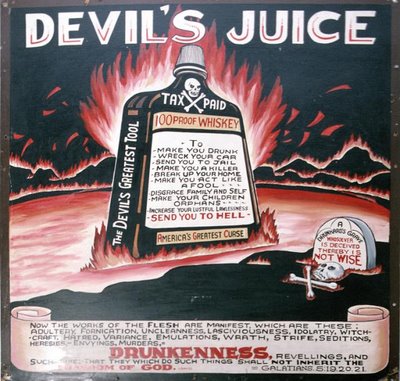 From personal experience, I can tell you that alcohol IS the Devil's Juice!!
Young people: BEWARE!!
Old people: BEWARE!!
In between people: BEWARE!
Drunkards: REPENT!
Clearing Things Up
Clearing Things Up
Instantly something like scales fell from Saul's eyes, and he regained his sight. Then he got up and was baptized -- Acts 9:18; New Living Translation
Roger Staubach, who led the Dallas Cowboys to the World Championship in 1972, admitted that his position as a quarterback who didn’t call his own signals was a source of trial for him. Coach Landry sent in every play. He told Roger when to pass, when to run and only in emergency situations could he change the play (and he had better be right!). Even though Roger considered coach Landry to have a “genius mind” when it came to football strategy, pride said that he should be able to run his own team. Roger later said, “I faced up to the issue of obedience. Once I learned to obey there was harmony, fulfillment, and victory.”
We could talk all day about obedience…literally. It comes down to doing it. The benefits of obedience are manifold. Roger Staubach learned that obedience leads to “harmony, fulfillment, and victory.” It leads to the same with our heavenly Father. Roger had to swallow his pride and listen to his coach. Ananias had to swallow his pride and go to Saul and do as God told him to do. Both cases got results. Roger’s obedience led to a championship. Ananias’ led to getting the greatest evangelist and missionary of all time started in ministry.
Obedience also clears things up. Once the “scales” were off Saul’s eyes he was baptized and began to preach. As the last devotion said, obedience came in two stages; Saul’s obedience in going into the city and Ananias’ obedience in going to Saul. Saul then “saw” clearly. He saw that Christ was the real deal. He began to “see” how all the Old Testament led to the Savior and that Jesus was that Savior. Saul then used all he had learned as a Pharisee to preach the truth of Christ. It started with an encounter with Christ, but continued with obedience.
I can’t help but think of the Prodigal Son. Luke 14 tells that story. A man had two sons; one wanted to do things his way, so he asked his father for his part of his inheritance. The father gave it to him and the boy spent it on wild living. The son found himself feeding pigs and starving to death. The King James Version says “he came to himself” (Luke 15:17a). The boy realized that doing it his way led him no where. He decided to go home, humble himself before his father, and become as obedient as a servant. The result was that the son was forgiven and exalted.
I wonder…what can be cleared up in our lives when we become obedient? The scales will come off of our eyes and we will come to our senses and see that we must do things God’s way. Obedience to God will always clear things up. We will experience harmony with our fellow man, fulfillment in living God’s purposes, and victory over sin and self.\
Instantly something like scales fell from Saul's eyes, and he regained his sight. Then he got up and was baptized -- Acts 9:18; New Living Translation
Roger Staubach, who led the Dallas Cowboys to the World Championship in 1972, admitted that his position as a quarterback who didn’t call his own signals was a source of trial for him. Coach Landry sent in every play. He told Roger when to pass, when to run and only in emergency situations could he change the play (and he had better be right!). Even though Roger considered coach Landry to have a “genius mind” when it came to football strategy, pride said that he should be able to run his own team. Roger later said, “I faced up to the issue of obedience. Once I learned to obey there was harmony, fulfillment, and victory.”
We could talk all day about obedience…literally. It comes down to doing it. The benefits of obedience are manifold. Roger Staubach learned that obedience leads to “harmony, fulfillment, and victory.” It leads to the same with our heavenly Father. Roger had to swallow his pride and listen to his coach. Ananias had to swallow his pride and go to Saul and do as God told him to do. Both cases got results. Roger’s obedience led to a championship. Ananias’ led to getting the greatest evangelist and missionary of all time started in ministry.
Obedience also clears things up. Once the “scales” were off Saul’s eyes he was baptized and began to preach. As the last devotion said, obedience came in two stages; Saul’s obedience in going into the city and Ananias’ obedience in going to Saul. Saul then “saw” clearly. He saw that Christ was the real deal. He began to “see” how all the Old Testament led to the Savior and that Jesus was that Savior. Saul then used all he had learned as a Pharisee to preach the truth of Christ. It started with an encounter with Christ, but continued with obedience.
I can’t help but think of the Prodigal Son. Luke 14 tells that story. A man had two sons; one wanted to do things his way, so he asked his father for his part of his inheritance. The father gave it to him and the boy spent it on wild living. The son found himself feeding pigs and starving to death. The King James Version says “he came to himself” (Luke 15:17a). The boy realized that doing it his way led him no where. He decided to go home, humble himself before his father, and become as obedient as a servant. The result was that the son was forgiven and exalted.
I wonder…what can be cleared up in our lives when we become obedient? The scales will come off of our eyes and we will come to our senses and see that we must do things God’s way. Obedience to God will always clear things up. We will experience harmony with our fellow man, fulfillment in living God’s purposes, and victory over sin and self.\
The Peace of a Clear Conscience
The Peace of a Clear Conscience
A Maskil of David. Blessed is the one whose transgression is forgiven, whose sin is covered. Blessed is the man against whom the LORD counts no iniquity, and in whose spirit there is no deceit. For when I kept silent, my bones wasted away through my groaning all day long. For day and night Your hand was heavy upon me; my strength was dried up as by the heat of summer. Selah. I acknowledged my sin to You, and I did not cover my iniquity; I said, "I will confess my transgressions to the LORD," and You forgave the iniquity of my sin. Selah. -- Psalm 32:1-5; English Standard Version
I have messed up so many times that I could give a million examples, but this one sticks out in my mind (along with a few other particular things). A teenager wrote me a letter and basically told me that I was arrogant and self-righteous. I got mad! I read that letter at least ten times. Finally, the truth of what that teenager was saying sunk into my thick head and hard heart. But, instead of admitting it openly to the teenager or to the Lord (most importantly), I tried to avoid it, justify it and deny it. Finally, as I was lying in bed one night unable to sleep, I confessed before the Lord how arrogant I had been. It was like a load of bricks was taken off of my shoulders. I felt so thoroughly forgiven by God that I arose from my bed and wrote that teenager a letter telling them exactly how right they were. I felt so empowered and humbled by the Lord's forgiveness that I knew I wanted my friend's forgiveness too. For the record, if my friend, Tiffany, reads this, I never delivered the letter; I told her in person.
Unconfessed sin is a canker to the spirit of a person. That is the clear and simple point of this devotion. We cannot live peacefully with unconfessed sin.
Am I perfect? Not by a long shot. However, there are three things that I want to do each day to ensure that I have peace in my life. Number one, I want to seek the presence of my Father. Number two, I want to serve Him with everything in me; I don't want to ever look back and feel like "I wish I had _________." Number three, and I have learned this the hard way over and over again, I do not want to have something unconfessed between me and my Lord.
I mean, c'mon, it's not like He doesn't know! What we do when we don't confess our sin before the Lord is we disagree with Him. If confession means "to agree" then it makes sense that lack of confession of sin means to disagree with God. The Greek word for confess (as in 1 John 1:9) means EXACTLY that -- to "agree" (or to "acknowledge"; or to "profess" -- Strong's #G3670). The Hebrew word, as in Psalm 32:5, means to hold out before Him our wrong (Strong's #3034). In both cases confession means to agree with God that we have sinned by honestly putting our cards out on the table.
Another of the inflections of the Hebrew word in Psalm 32:5 is to "cast away" our sin, meaning that, not only do we PROFESS it, but we FORSAKE it as well. Another inflection of that Hebrew word is that we "bemoan" that sin -- meaning we have godly sorrow over it.
Plainly speaking, when we make honest confession to the Lord it is as if we are saying, "God, You are right. I have ___________. I agree with You and I don't want to be like that. Please forgive me!"
It can be an attitude. I can be an action (mostly driven by an attitude of some sort, so we always need to get to the root). It can be a thought. The point for today is not what it is; rather, the point is to deal with it honestly and openly that we might receive forgiveness and peace from the Lord.
There is an old saying: "Confession is good for the soul." It's true. It's good for the soul of an individual. It's good for the soul of a church. It's good for the soul of a family. When we deal honestly with the Lord, He deals mercifully with us.
When we hold back we become eaten-up with what's inside of us. It becomes a weight and a burden. Often, and ALL of us are guilty at times, we suppress, deny, try to justify or try to cover up our sin. David, in writing this Psalm, said that his "bones wasted away" when he kept silent. Isn't that an awful picture? David was basically saying (my paraphrase), "It was killing me to hold back from You, Lord! I was getting old before my time!"
There is nothing better on this earth than peace with the Lord. A clear conscience is there for any and all who will confess and cast away their sin(s). David testified that when he confessed God "forgave". God is good like that! It's a restored relationship; nothing less.
Are you burdened by some unconfessed sin today? Agree with God. Cast it away. Be restored. Know peace. Be renewed.
A Maskil of David. Blessed is the one whose transgression is forgiven, whose sin is covered. Blessed is the man against whom the LORD counts no iniquity, and in whose spirit there is no deceit. For when I kept silent, my bones wasted away through my groaning all day long. For day and night Your hand was heavy upon me; my strength was dried up as by the heat of summer. Selah. I acknowledged my sin to You, and I did not cover my iniquity; I said, "I will confess my transgressions to the LORD," and You forgave the iniquity of my sin. Selah. -- Psalm 32:1-5; English Standard Version
I have messed up so many times that I could give a million examples, but this one sticks out in my mind (along with a few other particular things). A teenager wrote me a letter and basically told me that I was arrogant and self-righteous. I got mad! I read that letter at least ten times. Finally, the truth of what that teenager was saying sunk into my thick head and hard heart. But, instead of admitting it openly to the teenager or to the Lord (most importantly), I tried to avoid it, justify it and deny it. Finally, as I was lying in bed one night unable to sleep, I confessed before the Lord how arrogant I had been. It was like a load of bricks was taken off of my shoulders. I felt so thoroughly forgiven by God that I arose from my bed and wrote that teenager a letter telling them exactly how right they were. I felt so empowered and humbled by the Lord's forgiveness that I knew I wanted my friend's forgiveness too. For the record, if my friend, Tiffany, reads this, I never delivered the letter; I told her in person.
Unconfessed sin is a canker to the spirit of a person. That is the clear and simple point of this devotion. We cannot live peacefully with unconfessed sin.
Am I perfect? Not by a long shot. However, there are three things that I want to do each day to ensure that I have peace in my life. Number one, I want to seek the presence of my Father. Number two, I want to serve Him with everything in me; I don't want to ever look back and feel like "I wish I had _________." Number three, and I have learned this the hard way over and over again, I do not want to have something unconfessed between me and my Lord.
I mean, c'mon, it's not like He doesn't know! What we do when we don't confess our sin before the Lord is we disagree with Him. If confession means "to agree" then it makes sense that lack of confession of sin means to disagree with God. The Greek word for confess (as in 1 John 1:9) means EXACTLY that -- to "agree" (or to "acknowledge"; or to "profess" -- Strong's #G3670). The Hebrew word, as in Psalm 32:5, means to hold out before Him our wrong (Strong's #3034). In both cases confession means to agree with God that we have sinned by honestly putting our cards out on the table.
Another of the inflections of the Hebrew word in Psalm 32:5 is to "cast away" our sin, meaning that, not only do we PROFESS it, but we FORSAKE it as well. Another inflection of that Hebrew word is that we "bemoan" that sin -- meaning we have godly sorrow over it.
Plainly speaking, when we make honest confession to the Lord it is as if we are saying, "God, You are right. I have ___________. I agree with You and I don't want to be like that. Please forgive me!"
It can be an attitude. I can be an action (mostly driven by an attitude of some sort, so we always need to get to the root). It can be a thought. The point for today is not what it is; rather, the point is to deal with it honestly and openly that we might receive forgiveness and peace from the Lord.
There is an old saying: "Confession is good for the soul." It's true. It's good for the soul of an individual. It's good for the soul of a church. It's good for the soul of a family. When we deal honestly with the Lord, He deals mercifully with us.
When we hold back we become eaten-up with what's inside of us. It becomes a weight and a burden. Often, and ALL of us are guilty at times, we suppress, deny, try to justify or try to cover up our sin. David, in writing this Psalm, said that his "bones wasted away" when he kept silent. Isn't that an awful picture? David was basically saying (my paraphrase), "It was killing me to hold back from You, Lord! I was getting old before my time!"
There is nothing better on this earth than peace with the Lord. A clear conscience is there for any and all who will confess and cast away their sin(s). David testified that when he confessed God "forgave". God is good like that! It's a restored relationship; nothing less.
Are you burdened by some unconfessed sin today? Agree with God. Cast it away. Be restored. Know peace. Be renewed.
Subscribe to:
Posts (Atom)